

If you’re a project manager, you know the drill. You’ve got a beautiful architectural plan, the construction crew is making progress, and then someone asks: “So, when is the furniture arriving?” Suddenly, you’re looking at dozens of spreadsheets, lead times that don't match your move-in date, and a budget that looks a lot smaller than it did three months ago.
Budgeting forcommercial furnitureand coordinating a massive install isn't just about picking out ergonomic chairs. It’s a logistical puzzle that requires a deep understanding of FF&E procurement, shipping lead times, and on-site assembly.
At IFS Innovations, we’ve seen how quickly an office build-out can go sideways when the furniture is treated as an afterthought. To help you stay on track, we’ve broken down the process into five practical, high-impact steps.
Budgeting forcommercial furnitureand coordinating a massive install isn't just about picking out ergonomic chairs. It’s a logistical puzzle that requires a deep understanding of FF&E procurement, shipping lead times, and on-site assembly.
At IFS Innovations, we’ve seen how quickly an office build-out can go sideways when the furniture is treated as an afterthought. To help you stay on track, we’ve broken down the process into five practical, high-impact steps.
Step 1: Define Your Zones and Future-Proof Your Capacity
Before you even look at a catalog, you need to map out your space. But don't just count the heads you have today. A common mistake is buying for your current staff and leaving no room for growth. We recommend budgeting for 10-15% additional capacity right from the start.
Break your office down into functional zones:
Break your office down into functional zones:
- The Hubs: Individual workstations and private offices.
- The Collaboration Zones: Conference rooms, huddle spaces, and "war rooms."
- The Relief Zones: Breakrooms, kitchens, and lounge areas.
- The First Impression: Reception and waiting areas.
Each of these zones has a different cost profile. For instance, a reception area might require higher-end custom millwork to reflect your brand, while your back-of-house breakroom can focus more on durability and ease of cleaning.
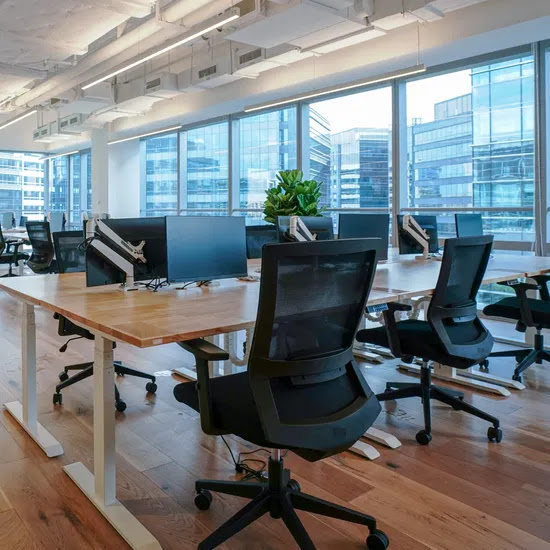
Pro Tip: Look for modular or reconfigurable furniture. If your team grows or your workflow changes in a year, you want pieces that can be shifted without requiring a whole new purchase.
Step 2: Focus on Total Cost of Ownership (TCO)
When you are looking at office furniture, the "sticker price" is rarely the final cost. In the world of FF&E procurement, we talk a lot about Total Cost of Ownership (TCO). This includes the initial price, but also:
- Durability: Will that $200 chair last two years or ten?
- Warranty: What happens when a pneumatic lift fails?
- Maintenance: Is the fabric stain-resistant for a high-traffic lobby?
It is tempting to go for the lowest per-unit price to keep the CFO happy. However, professional project managers know that cheap furniture often leads to "double-buying": replacing broken or uncomfortable pieces just 18 months down the line. Investing in mid-range or premium ergonomic options for your primary workstations is almost always the smarter financial move.
Step 3: Build a Realistic, Category-Based Budget
Once you have your zones and your TCO expectations, it’s time to put numbers to paper. A realistic budget needs to be broken down by category so you can see where your money is actually going.
Here is a rough benchmark for per-employee furniture budgeting in 2026:
- Basic/Essential: $1,000 – $1,500 per person.
- Mid-Range (Ergonomic-focused): $1,500 – $2,500 per person.
- Premium/Executive: $3,000+ per person.
Remember to prioritize! If you have to cut the budget, don't cut it on the things your employees use for eight hours a day. High-quality chairs and adjustable sit-stand desks are non-negotiable for employee well-being and productivity. You can save money on "ancillary" pieces like side tables or decorative shelving where the ergonomic impact is lower.
Pro Tip: If you're feeling overwhelmed by the procurement process, you aren't alone. We’ve written about 7 mistakes you’re making with FF&E procurement that can help you avoid the most common financial pitfalls.
Step 4: Account for "Soft Costs" (The Budget Killers)
This is where many project managers get blindsided. You’ve budgeted $100k for furniture, you’ve picked out the pieces, and then the quotes come back at $125k. Why? Soft costs.
In the commercial furniture world, you must account for:
- Freight & Shipping: Shipping heavy desks and chairs isn't cheap, especially with fluctuating fuel surcharges.
- Professional Installation: Modern office furniture is complex. It requires specialized tools and experienced crews to assemble properly.
- Warehousing: If your construction site isn't ready but the furniture is, you’ll need to pay for off-site storage.
- Taxes and Fees: Depending on your location, these can add a significant percentage to your total.
We usually recommend setting aside 8-15% of your total furniture expenditure just for these "soft costs."

Step 5: Master the Installation Logistics
The final step is the most stressful: the install. This is the moment when the furniture hits the floor. Coordination is key. You need to ensure that the electrical work is finished, the carpet is laid, and the elevators are padded and reserved.
A "single-source solution" is the secret weapon for project managers here. Instead of managing a furniture dealer, a separate shipping company, and an independent installation crew, you work with one team that handles the whole lifecycle.
At IFS Innovations, we pride ourselves on being that single-source partner. Because we handle construction and development alongside furniture, we know exactly when the site will be ready. We don't have to guess. We coordinate the delivery, the assembly, and the final placement so you can focus on your actual job: managing the project.

The IFS Innovations Advantage: One Team, One Contract
Why juggle five different vendors when you can have one? Our approach at IFS Innovations is built on the idea that "Design, Build, Inspire" should be a seamless process. Whether you are building a new medical office like the Urology Clinics of North Texas or a high-end restaurant, the principles remain the same: precision, transparency, and accountability.
By choosing a single-source solution for your office furniture and construction needs, you eliminate the finger-pointing that happens when something goes wrong. If a desk is damaged or a power pole doesn't line up with a workstation, you have one phone number to call. We own the problem from the first sketch to the last screw.
Final Touches
Budgeting and coordinating an office furniture install doesn't have to be a nightmare. If you define your needs early, focus on long-term value, account for those sneaky soft costs, and work with a partner who understands the "big picture" of commercial development, you’ll find the process is much smoother than you imagined.
Ready to start planning your next space? Take a look at our upcoming projects for some inspiration, or reach out to our team directly.
Let’s get to work.

Take the first step toward a stress-free build-out. Contact our team today to discuss your FF&E needs and how our single-source solution can save your project time and money.