

If you’re sitting at your desk right now reading this, take a quick second to check in with your body. Is your lower back tight? Are your shoulders creeping up toward your ears? Are your wrists resting on a sharp desk edge?
In 2026, the "office" isn't just a place where people show up to punch a clock; it’s a competitive advantage: or a liability. As we navigate a landscape where top talent has more choices than ever, the physical environment you provide speaks volumes about how much you value your team. At IFS Innovations, we’ve seen firsthand how a well-executed office furniture strategy does more than just fill a floor plan; it keeps your best people from looking for the exit.
Let’s dive into why ergonomics is no longer a "nice-to-have" and how it directly impacts your bottom line and employee retention.
The High Cost of the "Wrong" Chair
We talk to project managers and business owners every day who are focused on the "big" numbers: lease rates, construction timelines, and payroll. But there’s a hidden cost that often gets overlooked in FF&E procurement: the cost of discomfort.
According to recent 2026 data, the average cost of employee turnover has climbed to over $45,000 per person. When you factor in recruitment, onboarding, and the loss of institutional knowledge, losing a key team member is a massive financial hit. Now, compare that to the cost of a high-quality ergonomic workstation. The math starts to look very different.
Research shows that ergonomic interventions can reduce absenteeism by up to 67%. When people aren't calling out with back pain or repetitive strain injuries, they’re working. More importantly, when they feel physically supported by their employer, their "perceived organizational support" goes up. In plain English: if you care enough to give them a chair that doesn't hurt, they feel like you care about them as people.
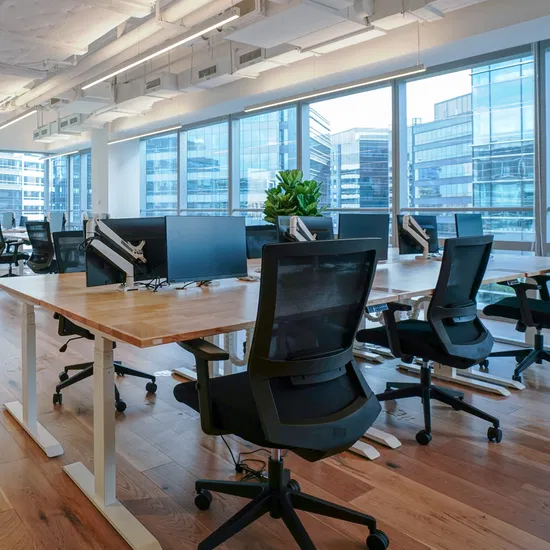
Comfort as a Retention Strategy in 2026
We’ve moved past the era of the "standard" cubicle. In 2026, the hybrid work model is the norm, with over half of remote-capable employees splitting their time between home and the office. This creates a unique challenge for commercial furniture planning.
When your team comes into the office, they expect an experience that is better than their home setup. If they have a great ergonomic chair at home but come into an office with 10-year-old "task chairs" that have lost their tension, they’re going to notice.
Pro Tip: Don't just buy furniture; buy flexibility. Sit-stand desks are no longer a luxury; they are a baseline expectation. Studies have shown that workers using stand-capable desks are nearly 45% more productive than those who remain seated all day.
The ROI of Ergonomic Investment
If you’re presenting a budget to stakeholders, lead with the ROI. For every dollar invested in ergonomic office solutions, organizations typically see a return of three to six dollars. This comes from:
- Reduced MSDs (Musculoskeletal Disorders): Cutting these by 40% or more significantly lowers insurance premiums and workers' comp claims.
- Increased Productivity: A comfortable employee is a focused employee.
- Boosted Satisfaction: Companies providing modern ergonomic workstations see a 24% jump in employee satisfaction scores.
When we handle FF&E procurement for our clients, we don't just look at the price tag. We look at the durability, the adjustability, and the long-term impact on the workforce.

Beyond the Hardware: Behavioral Ergonomics
One thing we’ve learned at IFS Innovations is that the best furniture in the world won’t help if your team doesn’t know how to use it. This is where "behavioral ergonomics" comes in.
It’s about encouraging movement. A well-designed office layout should prompt people to change postures, take micro-breaks, and rotate tasks. This is why we focus on integrated build-outs that combine office furniture with thoughtful space planning.
For example, in our work with the Royse City Chamber of Commerce, we looked at how the flow of the space encouraged natural movement. It’s not just about the desk; it’s about the break areas, the collaborative zones, and the "in-between" spaces that allow for postural variety.
The Single-Source Solution Advantage
Navigating a build-out is stressful enough without having to coordinate between an architect, a general contractor, and three different furniture vendors. This is where things often fall through the cracks: the "ergonomic vision" gets sacrificed to budget cuts or miscommunication.
At IFS Innovations, we advocate for a single-source solution. When you have one team handling the construction division and the furniture sourcing, the intent remains clear from design to installation. You get one contract, one point of contact, and a cohesive environment where the furniture actually fits the space it was intended for.

5 Steps to Level Up Your Office Ergonomics
If you’re looking to refresh your space to keep your team happy and healthy, here’s a practical roadmap:
- Audit Your Current Inventory: Walk the floor. Which chairs are sagging? Which desks are cluttered because of a lack of monitor arms?
- Prioritize Adjustability: In a hybrid world, "one size fits all" is a myth. Every piece of commercial furniture you buy should be adjustable to the individual.
- Invest in Lighting: Ergonomics isn't just about chairs. Proper lighting reduces eye strain and headaches. Look for energy-efficient LED options that mimic natural light.
- Create "Zones": Don't tie people to one spot. Provide lounge areas for focused work and collaborative tables for team sessions. Check out our upcoming projects for inspiration on multi-zone layouts.
- Train Your Team: Once the new gear arrives, show them how to adjust the lumbar support, set the monitor height, and use the sit-stand functions.

Final Touches
As we move through 2026, the definition of a "great place to work" continues to evolve. It’s no longer about ping-pong tables or free snacks. It’s about the fundamental way a workspace supports the human body and the human mind.
By investing in high-quality ergonomics, you aren't just buying desks and chairs. You’re buying lower turnover, higher morale, and a team that feels good enough to do their best work every day.
If you’re ready to rethink your office environment: from the studs in the wall to the chair at the desk: reach out to us at IFS Innovations. We’re here to help you design, build, and inspire.
Ready to start your next build-out?
Contact our team today and let's talk about how we can create a space your employees will never want to leave.